Standards for creating and maintaining technical documentation
Documentation is a critical deliverable for regulated software development. Good documentation enables knowledge transfer, supports compliance audits, and ensures systems can be maintained over time.
Documentation Principles
Principle
Description
Accurate
Documentation reflects the actual system state
Complete
All required information is present
Current
Updated as the system changes
Accessible
Easy to find and understand
Traceable
Links to requirements, code, and tests
Documentation Types
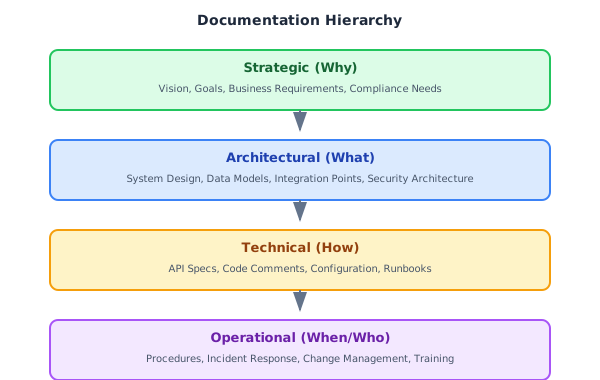
Documentation Hierarchy
Document Categories
Category
Purpose
Audience
Requirements
Define what the system must do
Stakeholders, Developers
Architecture
High-level system design
Architects, Tech Leads
Design
Detailed component design
Developers
API
Interface specifications
Integrators, Developers
User
End-user instructions
Users, Support
Operations
System administration
Operations, Support
Compliance
Regulatory evidence
Auditors, QA
Code Documentation
Inline Comments
// Comments should explain WHY, not WHAT

// Bad: Describes what the code does (obvious from reading it)
// Increment counter by 1
counter++;

// Good: Explains why this approach was chosen
// Use exponential backoff to avoid overwhelming the server
// during recovery from failures
const delay = Math.pow(2, retryCount) * baseDelayMs;

// Good: Explains a non-obvious business rule
// Tax exempt if customer is a registered non-profit
// See requirement REQ-TAX-001
if (customer.nonprofitStatus === 'verified') {
  return 0;
}
Function Documentation
/**
 * Calculates the total price for an order including taxes and discounts.
 *
 * @description Applies discounts first, then calculates tax on the
 * discounted amount. Rounds to 2 decimal places for currency precision.
 *
 * @param items - Line items in the order
 * @param discountCode - Optional promotional discount code
 * @param taxRate - Tax rate as decimal (e.g., 0.08 for 8%)
 * @returns Total price including tax, or null if calculation fails
 *
 * @example
 * const total = calculateOrderTotal(
 *   [{ price: 100, quantity: 2 }],
 *   'SAVE10',
 *   0.08
 * );
 * // Returns: 194.40 (200 - 10% discount = 180 + 8% tax)
 *
 * @throws {ValidationError} If items array is empty
 * @see REQ-PRICING-001 for business rules
 */
function calculateOrderTotal(
  items: OrderItem[],
  discountCode?: string,
  taxRate: number = 0
): number | null {
  // Implementation
}
Module Documentation
/**
 * @module PaymentProcessor
 *
 * @description
 * Handles all payment processing operations including credit card
 * transactions, refunds, and payment verification.
 *
 * ## Architecture
 * This module integrates with external payment gateways through
 * a provider abstraction layer, allowing different providers
 * to be used without changing business logic.
 *
 * ## Security
 * - No card numbers are stored locally
 * - All data encrypted in transit (TLS 1.3)
 * - PCI DSS compliant
 *
 * ## Dependencies
 * - PaymentGateway: External payment provider interface
 * - AuditLogger: Compliance logging service
 *
 * @see docs/architecture/payment-flow.md
 */
API Documentation
OpenAPI Specification
openapi: 3.0.3
info:
  title: Order Management API
  description: |
    API for managing customer orders in the e-commerce platform.

    ## Authentication
    All endpoints require Bearer token authentication.

    ## Rate Limiting
    - 100 requests per minute per API key
    - 429 response when exceeded
  version: 1.0.0

paths:
  /orders:
    post:
      summary: Create a new order
      description: |
        Creates a new order for the authenticated customer.
        Validates inventory availability before accepting.
      operationId: createOrder
      tags:
        - Orders
      requestBody:
        required: true
        content:
          application/json:
            schema:
              $ref: '#/components/schemas/CreateOrderRequest'
            example:
              items:
                - productId: "prod-123"
                  quantity: 2
              shippingAddress:
                street: "123 Main St"
                city: "Seattle"
                state: "WA"
                zipCode: "98101"
      responses:
        '201':
          description: Order created successfully
          content:
            application/json:
              schema:
                $ref: '#/components/schemas/Order'
        '400':
          description: Invalid request
        '409':
          description: Inventory not available
Architecture Documentation
Architecture Decision Records (ADRs)
# ADR-001: Use PostgreSQL for Primary Database

## Status
Accepted

## Context
We need to select a primary database for the order management system.
Requirements include:
- ACID compliance for financial transactions
- Support for complex queries and reporting
- Horizontal read scaling capability
- Strong ecosystem and community support

## Decision
We will use PostgreSQL as our primary database.

## Consequences

### Positive
- Mature, well-documented technology
- Excellent JSON support for flexible schemas
- Strong transaction guarantees
- Rich extension ecosystem (PostGIS, TimescaleDB)

### Negative
- Vertical scaling limits for writes
- More complex to operate than managed NoSQL options

### Mitigation
- Use read replicas for reporting queries
- Implement caching layer for frequently accessed data

## Related
- REQ-DATA-001: Data integrity requirements
- ADR-003: Caching strategy
System Diagrams
Use standard notation for diagrams:
Diagram Type
Purpose
Format
Context
System boundaries and external actors
C4 Level 1
Container
High-level technology choices
C4 Level 2
Component
Internal structure of containers
C4 Level 3
Sequence
Runtime behavior and flows
UML
ER Diagram
Data model relationships
UML/ERD
Operational Documentation
Runbook Structure
# Service: Order Processing Service

## Overview
Handles order creation, validation, and fulfillment coordination.

## Health Checks
- **Endpoint**: `/health`
- **Expected**: HTTP 200 with `{"status": "healthy"}`
- **Timeout**: 5 seconds

## Dependencies
| Service | Purpose | Criticality |
|---------|---------|-------------|
| PostgreSQL | Order storage | Critical |
| Payment API | Payment processing | Critical |
| Inventory API | Stock validation | High |
| Email Service | Notifications | Low |

## Common Issues

### Issue: High Latency
**Symptoms**: Response times > 2 seconds
**Investigation**:
1. Check database connection pool (`/metrics`)
2. Review slow query logs
3. Check downstream service health

**Resolution**:
- If connection pool exhausted: Restart service
- If slow queries: Escalate to DBA

### Issue: Payment Failures
**Symptoms**: Increased 500 errors on /orders endpoint
**Investigation**:
1. Check payment gateway status
2. Review payment service logs
3. Verify API credentials

**Resolution**:
- If gateway down: Enable fallback provider
- If credential issue: Rotate and update secrets
This section fulfills ISO 13485 requirements for documentation requirements (4.2), control of documents (4.2.3), and control of records (4.2.4), and ISO 27001 requirements for documented information (7.5), operating procedures documentation (A.5.37), and information security documentation (5.2).