On this page
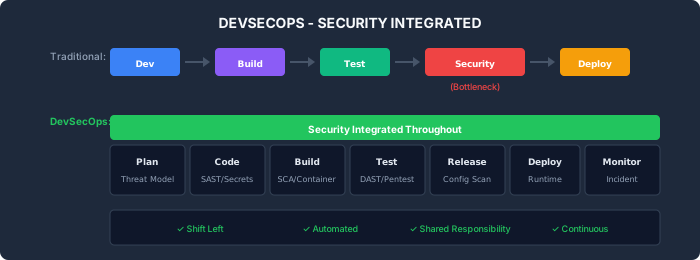
DevSecOps integrates security practices into every phase of the DevOps lifecycle. Rather than treating security as a gate at the end, DevSecOps makes security a shared responsibility across development, security, and operations teams.
What is DevSecOps?
DevSecOps Integration Security in Each Phase
Plan Phase
Code Phase
Build Phase
Test Phase
Deploy Phase
Operate Phase
DevSecOps Pipeline
Complete Security Pipeline
name: DevSecOps Pipeline
on: [push, pull_request]

jobs:
  # Pre-commit security checks
  secrets-scan:
    runs-on: ubuntu-latest
    steps:
      - uses: actions/checkout@v4
        with:
          fetch-depth: 0
      - uses: gitleaks/gitleaks-action@v2
        env:
          GITHUB_TOKEN: ${{ secrets.GITHUB_TOKEN }}

  # Static analysis
  sast:
    runs-on: ubuntu-latest
    steps:
      - uses: actions/checkout@v4
      - uses: returntocorp/semgrep-action@v1
        with:
          config: >-
            p/security-audit
            p/secrets
            p/owasp-top-ten

  # Dependency scanning
  sca:
    runs-on: ubuntu-latest
    steps:
      - uses: actions/checkout@v4
      - run: npm ci
      - run: npm audit --audit-level=high
      - uses: snyk/actions/node@master
        env:
          SNYK_TOKEN: ${{ secrets.SNYK_TOKEN }}

  # Build with security
  build:
    needs: [secrets-scan, sast, sca]
    runs-on: ubuntu-latest
    steps:
      - uses: actions/checkout@v4
      - run: npm ci && npm run build
      - name: Build Docker image
        run: docker build -t myapp:${{ github.sha }} .

  # Container scanning
  container-scan:
    needs: build
    runs-on: ubuntu-latest
    steps:
      - uses: aquasecurity/trivy-action@master
        with:
          image-ref: myapp:${{ github.sha }}
          severity: 'HIGH,CRITICAL'
          exit-code: '1'

  # Infrastructure scanning
  iac-scan:
    runs-on: ubuntu-latest
    steps:
      - uses: actions/checkout@v4
      - uses: bridgecrewio/checkov-action@v12
        with:
          directory: infrastructure/

  # Dynamic testing (staging)
  dast:
    needs: [build, container-scan]
    runs-on: ubuntu-latest
    environment: staging
    steps:
      - name: Deploy to staging
        run: ./deploy.sh staging
      - name: OWASP ZAP Scan
        uses: zaproxy/action-baseline@v0.7.0
        with:
          target: 'https://staging.example.com'

  # Deploy to production
  deploy:
    needs: [dast, iac-scan]
    runs-on: ubuntu-latest
    environment: production
    steps:
      - name: Deploy to production
        run: ./deploy.sh production
Security Gates
Quality Gates Configuration
# sonar-project.properties
sonar.qualitygate.wait=true
sonar.qualitygate.timeout=300

# Quality gate conditions
# - Coverage > 80%
# - No new critical vulnerabilities
# - No new security hotspots
# - Duplicated lines < 3%
Pipeline Gate Implementation
security-gate:
  runs-on: ubuntu-latest
  needs: [sast, sca, container-scan]
  steps:
    - name: Check Security Gate
      run: |
        # Fail if any critical/high vulnerabilities
        if [ "$CRITICAL_VULNS" -gt 0 ] || [ "$HIGH_VULNS" -gt 5 ]; then
          echo "Security gate failed!"
          exit 1
        fi

        # Fail if secrets detected
        if [ "$SECRETS_FOUND" == "true" ]; then
          echo "Secrets detected in code!"
          exit 1
        fi

        echo "Security gate passed"
Security Scanning Configuration
Semgrep (SAST)
# .semgrep.yml
rules:
  # SQL Injection
  - id: sql-injection
    patterns:
      - pattern: $DB.query($QUERY + ...)
    message: Potential SQL injection
    severity: ERROR
    languages: [javascript, typescript]

  # Hardcoded secrets
  - id: hardcoded-password
    pattern-regex: password\s*=\s*['"][^'"]+['"]
    message: Hardcoded password detected
    severity: ERROR

  # Insecure crypto
  - id: weak-crypto
    patterns:
      - pattern: crypto.createHash('md5')
      - pattern: crypto.createHash('sha1')
    message: Weak cryptographic hash
    severity: WARNING
Trivy (Container)
# trivy.yaml
severity:
  - CRITICAL
  - HIGH

ignore-unfixed: true

security-checks:
  - vuln
  - config
  - secret

exit-code: 1
Checkov (IaC)
# .checkov.yaml
framework:
  - terraform
  - kubernetes

skip-check:
  - CKV_AWS_123  # Skip specific check with documented reason

soft-fail: false
compact: true
Secrets Management
Detecting Secrets
# .gitleaks.toml
title = "Gitleaks Configuration"

[extend]
useDefault = true

[[rules]]
id = "custom-api-key"
description = "Custom API Key"
regex = '''(?i)(api[_-]?key|apikey)\s*[:=]\s*['"]?([a-zA-Z0-9]{32,})['"]?'''
secretGroup = 2

[allowlist]
paths = [
  '''test/.*''',
  '''\.md$''',
]
Secure Secrets Handling
# Use GitHub secrets
env:
  DATABASE_URL: ${{ secrets.DATABASE_URL }}
  API_KEY: ${{ secrets.API_KEY }}

# Or fetch from secrets manager
- name: Get secrets from AWS
  uses: aws-actions/aws-secretsmanager-get-secrets@v1
  with:
    secret-ids: |
      prod/database
      prod/api-keys
Runtime Security
Kubernetes Security Policies
# Pod Security Policy
apiVersion: policy/v1beta1
kind: PodSecurityPolicy
metadata:
  name: restricted
spec:
  privileged: false
  runAsUser:
    rule: MustRunAsNonRoot
  seLinux:
    rule: RunAsAny
  fsGroup:
    rule: RunAsAny
  volumes:
    - 'configMap'
    - 'emptyDir'
    - 'projected'
    - 'secret'
    - 'downwardAPI'
    - 'persistentVolumeClaim'
  readOnlyRootFilesystem: true
  allowPrivilegeEscalation: false
Network Policies
apiVersion: networking.k8s.io/v1
kind: NetworkPolicy
metadata:
  name: api-network-policy
spec:
  podSelector:
    matchLabels:
      app: api
  policyTypes:
    - Ingress
    - Egress
  ingress:
    - from:
        - podSelector:
            matchLabels:
              app: web
      ports:
        - protocol: TCP
          port: 8080
  egress:
    - to:
        - podSelector:
            matchLabels:
              app: database
      ports:
        - protocol: TCP
          port: 5432
Security Metrics
Key Metrics to Track
Dashboard
┌─────────────────────────────────────────────────────────────────────────────┐
│                    DEVSECOPS DASHBOARD                                       │
├─────────────────────────────────────────────────────────────────────────────┤
│                                                                              │
│  Open Vulnerabilities          Security Gate Status                          │
│  ┌────┐ ┌────┐ ┌────┐         ┌───────────────────┐                         │
│  │ 0  │ │ 5  │ │ 23 │         │ ✅ SAST Passed    │                         │
│  │Crit│ │High│ │Med │         │ ✅ SCA Passed     │                         │
│  └────┘ └────┘ └────┘         │ ✅ Secrets Clean  │                         │
│                                │ ✅ Container OK   │                         │
│  MTTR (Critical): 2.1 days    │ ✅ DAST Passed    │                         │
│  MTTR (High): 5.3 days        └───────────────────┘                         │
│                                                                              │
│  Vulnerability Trend (30 days)                                              │
│  ┌────────────────────────────────────────────────────────────────┐        │
│  │ 50 ▄                                                           │        │
│  │ 40 █▄                                                          │        │
│  │ 30 ██▄▄▄                                                       │        │
│  │ 20 █████▄▄▄▄▄▄▄▄▄▄                                            │        │
│  │ 10 ████████████████▄▄▄▄                                        │        │
│  └────────────────────────────────────────────────────────────────┘        │
│                                                                              │
└─────────────────────────────────────────────────────────────────────────────┘
Compliance Integration
Audit Evidence
DevSecOps generates compliance evidence automatically:
Regulatory Mapping
Best Practices
Do
Shift security left (earlier in pipeline)
Automate security testing
Make security everyone's responsibility
Fix vulnerabilities quickly
Track security metrics
Conduct regular threat modeling
Keep security tools updated
Don't
Treat security as a gate at the end
Ignore false positives (tune tools)
Skip security for speed
Store secrets in code
Deploy with critical vulnerabilities
Rely solely on automated tools
Compliance
This section fulfills ISO 13485 requirements for risk management (7.1), design verification (7.3.6), and validation of processes (7.5.2), and ISO 27001 requirements for secure development lifecycle (A.8.25), security testing (A.8.29), vulnerability management (A.8.8), and secure coding (A.8.28).
View full compliance matrix