
Healthcare Data Strategy & Reference Architecture
Healthcare data lake service · Case study
Designing a business-aligned foundation for interoperable clinical and operational data
- Organization
- Healthcare organization
- Engagement
- Data strategy and reference-architecture advisory
The engagement at a glance
Netspective supported a healthcare organization in assessing a complex data and integration landscape and developing a business-aligned reference architecture. The work focused on how clinical, operational, financial and research information could be acquired, governed, integrated and made available for authorized use as underlying systems evolved. The available record supports an advisory and architecture-design contribution; it does not establish production implementation or ongoing operation.
Business challenge
Complex legacy systems, duplicated content and point-to-point integrations made interoperability and modernization difficult.
Our contribution
Discovery, data-strategy guidance, reference architecture, guiding principles and stakeholder-facing use-case explanations.
Delivery boundary
Phase I architecture and advisory work. The available record does not establish a production data-lake implementation by Netspective.
The reference architecture
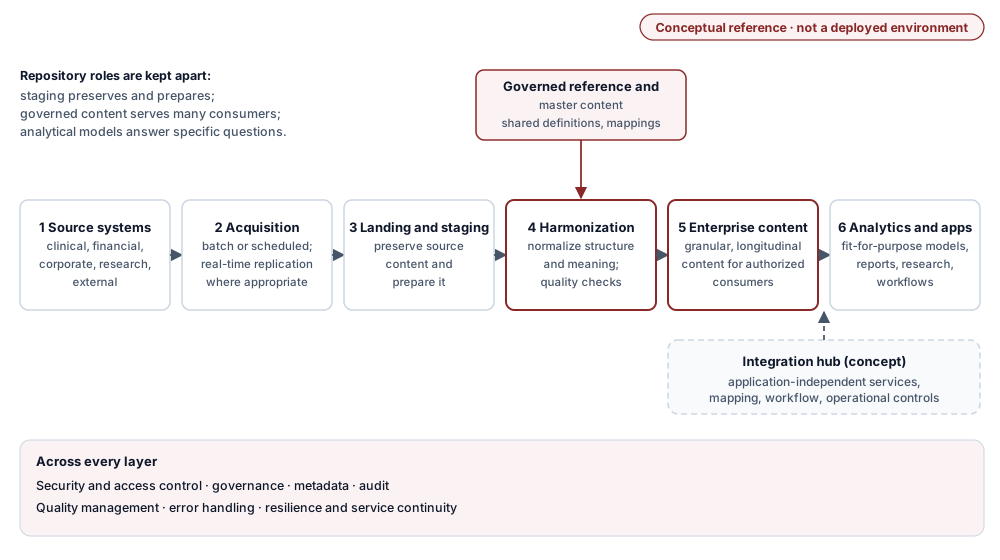
Six layers: source systems (clinical, financial, corporate, research and external); acquisition (batch or scheduled extraction, and real-time replication where appropriate); landing and staging (preserve source content and prepare it); harmonization and quality (normalize structure and meaning using governed reference and master content); enterprise content services (granular, longitudinal content for multiple authorized consumers); and analytics and applications (fit-for-purpose models, reports, research and operational workflows). An application-independent integration hub concept mediates service interactions, mapping and workflow between applications. Security and access control, governance, metadata, audit, quality management, error handling and service continuity apply across every layer.
The challenge
The organization's information environment included multiple clinical, financial, research and supporting applications, with duplicated content, separate repositories and tightly coupled point-to-point interfaces. These patterns can make it difficult to establish consistent meaning, determine which source is authoritative for a particular data element, safely exchange information between applications and support new analytics without creating yet another data copy. Modernization also needed to account for continuity of existing workflows and the different responsibilities of clinical, operational, research and IT stakeholders.
- Reduce unnecessary duplication while retaining copies required for operational, legal or continuity reasons.
- Improve semantic consistency and data quality across systems and repositories.
- Clarify ownership, governance and accountability for data across clinical, research and IT functions.
- Enable interoperable services and controlled application integration, including consideration of safe write-back workflows.
- Support modernization incrementally rather than relying on a disruptive, single-step replacement.
Our approach
The work combined review of the current-state architecture and available data/governance materials with development of a high-level data strategy and logical reference architecture. Rather than prescribing a single technology implementation, the approach organized the problem around business capabilities: acquiring information from source systems, staging and managing copies deliberately, harmonizing data, exposing governed enterprise content, integrating applications through reusable services, and supporting downstream analytics. Architecture choices were framed as principles and trade-offs for stakeholder review.
- Current-state assessment Reviewed available architecture and data materials to identify source-system categories, existing repositories, replication patterns, point-to-point interfaces, integration dependencies and governance concerns. The assessment provided a structured view of constraints and opportunities; the supplied record does not quantify the full application inventory or establish that every system was independently validated.
- Business-aligned reference architecture Developed a conceptual, layered model linking business information needs to acquisition, staging, harmonization, governed enterprise content, integration services, analytics models and consuming applications. The model was intended to support incremental modernization and multiple authorized uses without treating a single physical repository as the answer to every problem.
- Interoperability and integration Outlined an application-independent integration-hub concept for mediating service interactions, mapping between data structures, coordinating workflow and applying operational controls. The intent was to reduce brittle direct dependencies and allow systems to evolve behind clearer interfaces. This was a proposed integration pattern, not evidence of a deployed hub.
- Replication and repository strategy Addressed when to retain source copies, when replicated data is justified for operational or continuity reasons, and when additional copies create avoidable complexity. The design direction was to make replication purposeful, with an identified use, owner, freshness expectation and lifecycle, while separating interim/staging stores from governed enterprise content and analytics-specific models.
- Governed master and reference content Identified shared reference and master data as a way to improve semantic consistency across applications. The architecture considered common definitions, mappings and controlled access to reference/master content, while recognizing that authoritative ownership may differ by domain. It did not establish that a specific master-data platform or centralized repository was implemented.
- Stakeholder review and decision-making The reference model was intended to support discussion among business, clinical, research, data and IT stakeholders. Use cases and practical scenarios helped make architectural trade-offs understandable, including data ownership, replication, interoperability, write-back considerations and the balance between shared services and domain-specific needs. The available material describes stakeholder-review activity, not formal approval by every stakeholder or a measured adoption outcome.
- Repository roles The architecture distinguishes temporary landing/staging areas from governed enterprise content and from analytical models built for specific reporting or research needs. A staging area can preserve and prepare source data; governed content services can make approved information available across authorized consumers; analytical models can then shape data for particular questions. These roles should not be conflated, and retention or replication should be justified by an operational, legal, continuity or analytical requirement.
- Governance and operating principles The design addressed clear data ownership, access control, metadata, auditability, quality management, error handling, resilience and service continuity as cross-cutting responsibilities. These principles are intended to make information trustworthy and manageable across its lifecycle. The source materials do not establish a complete implemented governance operating model, named governance committees or production service-level commitments.
Reference architecture at a glance
The proposed model separated the movement of data from its governed management and downstream use. It was a logical reference architecture, not a record of a deployed environment.
- Source systems Clinical, financial, corporate, research and external information sources
- Acquisition Batch/scheduled extraction and real-time replication where appropriate
- Landing and staging Preserve source content and prepare it for downstream processing
- Harmonization and quality Normalize structures and meaning using governed reference/master content
- Enterprise content services Manage granular, longitudinal content for multiple authorized consumers
- Analytics and applications Create fit-for-purpose models, reports, research and operational workflows
Cross-cutting considerations: security and access control, governance, metadata, audit, quality management, error handling and service continuity.
Key architectural decisions and principles
- Separate enterprise content management from analytics-specific models instead of creating a permanent copy for every use case.
- Use shared services and governed reference/master content to improve consistency across applications.
- Make source-of-truth ownership explicit; do not assume one universal authoritative source for every data domain.
- Use batch and real-time acquisition patterns according to business and operational requirements.
- Keep integration services application-independent where feasible, allowing consumer-facing contracts to remain stable as underlying systems change.
- Treat resilience, security, audit, error management and governance as cross-cutting design concerns.
- Adopt incremental, process-led implementation: validate a focused business or clinical workflow before expanding.
Deliverables and engagement outcome
- Discovery and current-state assessment content based on the materials and discussions available during the engagement.
- High-level data strategy and reference-architecture framework with conceptual layers and reference diagrams.
- Guiding principles for replication, repositories/interim stores, interoperability, reference/master data and governance.
- Use-case and stakeholder review materials, including architecture explanations and responses to business and technical questions.
- Completion of the documented advisory and reference-architecture work. The available material does not provide a verified production go-live date or evidence of ongoing operations.
The available record supports an architecture-planning contribution. It does not establish quantified business results, production deployment, measured performance improvements, or operation of a managed service.
What this experience demonstrates
This engagement illustrates Netspective's experience in healthcare data strategy and architecture: assessing fragmented data environments, translating business needs into an interoperability-oriented reference model, defining practical data-governance and replication principles, and planning for modernization with continuity in mind.
For organizations considering a similar initiative, a practical starting point is a scoped discovery and architecture phase that establishes priority use cases, source-system constraints, governance responsibilities, target-state principles and an incremental implementation roadmap.
Scope and evidence note
This case study summarizes historical healthcare data-strategy and reference-architecture advisory work. The architecture was proposed and is not verified as built by Netspective. No production implementation, operational SLA, measured savings or clinical outcome is claimed. This version excludes the customer's name, individual names, specific dates, original diagrams/screenshots, internal labels and other details that could identify the organization. Any public use should still be reviewed against applicable confidentiality and contractual obligations.
What the evidence supports — and what it does not
Supported by the available record
- Discovery and current-state assessment content based on the materials and discussions available during the engagement.
- A high-level data strategy and a conceptual, layered reference architecture with reference diagrams.
- Guiding principles for replication, repositories and interim stores, interoperability, reference/master data and governance.
- Use-case and stakeholder review materials, including architecture explanations and responses to business and technical questions.
- Completion of the documented advisory and reference-architecture work.
Not established by the available record
- A production data-lake implementation by Netspective, or deployment of the reference architecture.
- A deployed integration hub, or an implemented master-data platform or centralized repository.
- A complete implemented governance operating model, named governance committees or production service-level commitments.
- Formal approval by every stakeholder, or a measured adoption outcome.
- A verified production go-live date, ongoing operations or a managed service.
- Quantified business results, measured savings, performance improvements or clinical outcomes.